

source: Tesha Simpson Smith/Facebook
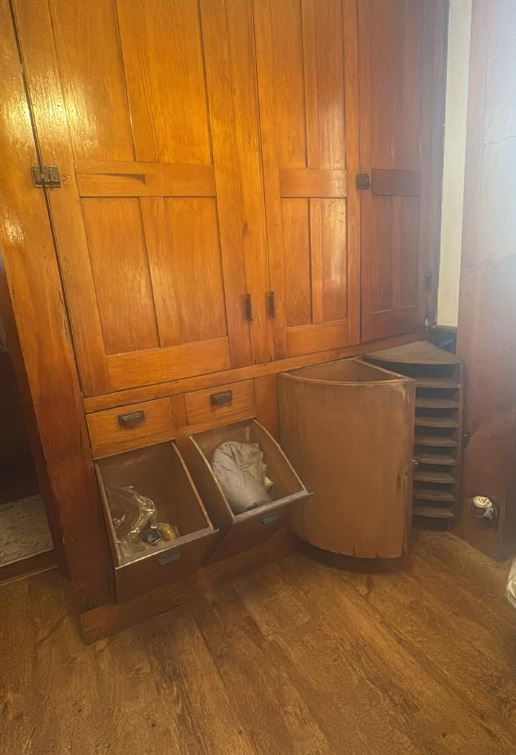
Kitchens of yesteryear were engineered to store dry goods on a large scale. They were also designed to be cooking centers and to maximize efficiency. One of the most brilliant inventions of those early days is the old fashioned pantry bin.
Those built-in storage units were not just quaint pieces of history. They were made to order, carefully constructed and necessary to create the routine of a well run home.
Functional for Bulk and Made to Endure
When households bought flour, sugar and grains in massive quantities, typical kitchen cabinets simply would not suffice. As a result, homes of that era were equipped with deep, sloping or lifting bins that could hold anywhere from 25 to 50 lbs. of dry goods. Most of these old style pantry bins were built into the cabinetry as part of the original plan – not as an after-thought.
You could easily pull out what you needed from each bin – without having to handle heavy bags or the hassle of opening and closing variously shaped lids. When you opened a bin the grain or flour was funneled to the front because of the slant of the design. The wooden construction kept everything cool and dry.
No plastic. No sealants. Just wood, nails and a bit of everyday practicality.
A Place for Everything
Most old kitchens had several bins – each one designated for a particular item. Flour and sugar were the most commonly stored items, however some households used them to store oatmeal, beans, rice and so forth. Larger houses may have had individual bins for coffee, cornmeal and/or salt.
Storage of this nature was not done for fashion or minimalism; rather it was to make the running of a household as efficient as possible, especially since meals were prepared from scratch at least three times per day.
Some bins even came with scoops attached to the inside lid using string or twine – allowing you to quickly locate whatever was needed in the bin when your hands were covered in flour.
Temporary and Long Term Storage
Pantry bins were excellent for dry staples, although sometimes they were also used as a short term storage unit for items such as onions, potatoes or bread. Long term storage for vegetables generally occurred in the root cellar or cold cellar – where there was a consistent temperature that allowed for long periods of freshness of the vegetable.
However, the pantry bins provided a convenient location for accessing the vegetables temporarily. Only enough potatoes for the week. That freshly baked loaf of bread from earlier that day. It was all about finding a balance between preserving food and being able to access it.
The Handcrafted Nature of Yesteryear
There is something endearing about holding an old wooden bin – solid in your hand, worn smooth over the years of use. These were not mass produced containers. Each was custom-made by a cabinetmaker, fitted perfectly into the structure of the home.
And they have endured. Many of these old pantry bins still work as well today as they did 80 or 100 years ago.
It was not merely the material quality of the bins that has led to their longevity – it was also their simple design. There were no hinges to break. No complex systems to fail. Just straight lines, intelligent angles and genuine wood.
A Return to Simplicity
Today’s kitchens see a resurgence in popularity of the old-fashioned pantry bins. Owners of older homes are either choosing to retain them or build new ones entirely. And why wouldn’t they? These bins provide a tangible link to the past, a chance to slow down and cook with purpose.
They illustrate that sometimes the convenience comes from being connected to our past – and not necessarily from modern technology. Simply reaching into a bin for a scoop of flour that has been part of the kitchen for longer than any appliance is an example of how we can connect again to a simpler time.
More Than a Charming Detail
Old-fashioned pantry bins are more than just a nostalgic reminder of the past. They represent a time when homes were designed around the daily lives of people. Their storage was designed to fit the natural rhythms of the daily routines – and not based solely upon aesthetics.
They are a small, quiet element. However, like much of the rest of what came from the “good old days,” they possess a certain wisdom that we could use more of in our lives today.


